%201.svg)


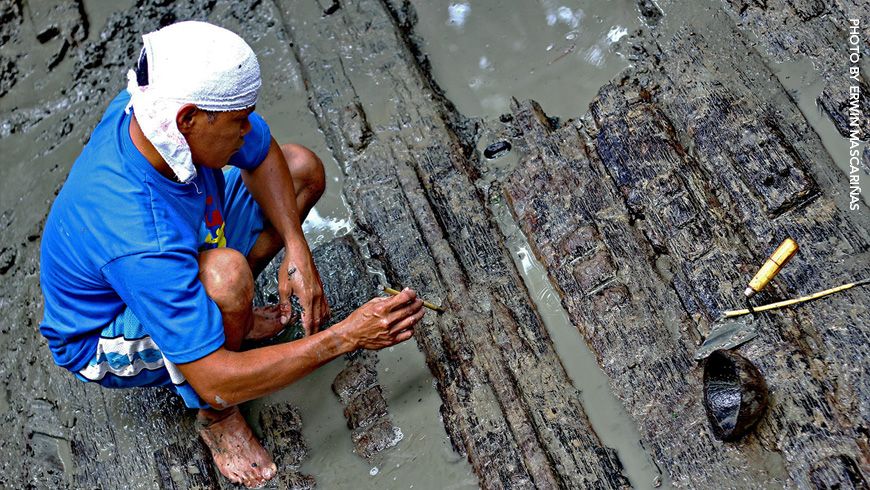
BUTUAN CITY — What began as an effort to drain water in Butuan in the 1970s led to one of the Philippines’ most important archaeological discoveries.
Now, 50 years after the first balangay excavation, archaeologists are digging again in Barangay Libertad, and more ancient boat remains may have surfaced.
The National Museum of the Philippines said the original archaeological finds in Butuan were discovered accidentally in the 1970s when the City Engineering Office was draining water trapped inside an artificial river system. Subsequent excavations revealed the remains of the ancient Butuan boats.
The first balangay was excavated in Libertad in 1976.
The wooden vessels, individually dated between 689 and 988 CE, provided physical evidence of sophisticated boatbuilding and maritime activity in the area more than a thousand years ago. Archaeological finds, including imported ceramics, also show that ancient Butuan was connected to trade networks involving China and other parts of Southeast Asia, centuries before the modern Philippine nation-state.
Today, archaeologists have returned to the same part of Butuan.
During recent confirmatory excavations at two sites in Barangay Libertad, National Museum researchers documented wooden remains displaying characteristics associated with the historic Butuan boats.
At the privately owned Torralba site, archaeologists uncovered three wooden planks. One contained lugs, or projections carved into the wood that were used in the construction of the ancient vessels.
At another excavation area known as the Toyota site, archaeologists exposed about 10 meters of wooden planking containing features such as dowel holes and scarf joints associated with Butuan boat construction.
The discoveries raise the possibility that archaeologists have found another ancient vessel.
But the National Museum has not yet officially declared it a newly discovered balangay.
Nero Austero of the National Museum’s Maritime and Underwater Cultural Heritage Division said researchers must first determine whether the newly documented remains correspond to boats mentioned in older records or represent a vessel that had never been formally recorded.
Researchers are reviewing previous reports, photographs and archaeological records before determining whether the remains could eventually be identified as another numbered Butuan boat.
The uncertainty reflects the complicated archaeological history of the area. Historical accounts refer to as many as 11 Butuan boats, while documentation of some of the sites remains incomplete.
What is already clear is the significance of the location itself.
The ancient boats were discovered in a former riverine environment in Libertad alongside other archaeological materials. Their construction demonstrates advanced plank-built and edge-pegged boatbuilding techniques used by communities that traveled, traded and maintained links across maritime Southeast Asia.
The National Museum now manages the Butuan Boat Site Museum in Libertad, where the excavation site of Butuan Boat 1 and artifacts connected to the discoveries are preserved.
Half a century after workers accidentally uncovered traces of Butuan’s past while dealing with water, the same ground is again giving archaeologists clues about the people who once navigated those waters.
Whether the latest remains become another officially recognized balangay is still under study.
But they reinforce what decades of archaeology have already established: long before the Philippines existed as a modern nation, Butuan was already part of a thriving maritime world.













.png)
.png)



.png)