


%201.svg)


Emergency Hotline:
(+63) 2 911 – 8688



The Department of Justice (DOJ) has confirmed that former AKO Bicol Party-list Representative Zaldy Co is no longer within the territory of the Czech Republic, following a high-level meeting between Philippine and Czech officials.
The development was revealed around 8 p.m. PHT, after the Philippine delegation met with their Czech counterparts. Czech Minister of Justice officially informed DOJ Secretary Fredderick Vida that Co was no longer in their custody.
"I have to share difficult news, mga kababayan. Czech authorities have informed us that Mister Zaldy Co is no longer in their custody. What we can confirm is that he is within the Schengen area," Secretary Vida said.
Despite the confirmation of his departure from Czech territory, Philippine officials believe the former lawmaker remains somewhere in Europe.
Vida noted that while they sought additional information, Czech authorities cited Schengen rules and data privacy laws as limitations. He added, however, that the conversation pointed toward the possibility of police cooperation, something that is currently still under negotiation between the Philippine and Czech governments.
"They were pointing to a possible police cooperation which we don't have, which is currently ongoing negotiation between the Philippine Government and Czech Republic," Vida said.
Meanwhile, the DOJ disclosed that it holds details regarding the vehicle used by Co during his time in Czech Republic, which has since become part of an active intelligence operation.
"Definitely he is travelling by land. We're also aware — we got information as to the registry of the vehicle, we also got information as to who the driver is," Vida said.
Earlier reports indicated that the former lawmaker was intercepted at the Czech-German border due to an immigration violation.
It was also confirmed that Co was found carrying three Philippine passports. Vida said their verification with the Bureau of Immigration revealed that Co had been issued three passports, one of which, an expired passport that lapsed on September 11, 2022, was the one he had in his possession when he was accosted by authorities.
The two others include an official passport issued during his term as a congressman, and another passport that had been cancelled by Philippine courts.
Secretary Vida and the Philippine delegation are set to remain in Czech Republic until April 30.
While the DOJ expressed disappointment over not being able to bring Co back with them to the Philippines, officials said they will work to expedite law enforcement mechanisms, including the processing of a Red Notice and the establishment of international police cooperation.

The Philippines has received all four shipments of diesel procured by the government through the Philippine National Oil Company-Exploration Corporation (PNOC-EC), equivalent to an additional five days of supply for the country.
Department of Energy (DOE) Undersecretary Alessandro "Sandy" Sales said the deliveries were completed over the span of one month, with the first two crude shipments offloaded in La Union and Batangas before the end of March, the third discharged in Subic, and the fourth unloaded in Davao City on Monday, April 27.
"So, in total, 'yong apat na cargoes na ito delivered from March 25 to early this morning in a span of one month totaled about 178 million liters of diesel. Essentially, that's about 5 days buffer stock," Sales said.
["In total, the four cargo shipments delivered from March 25 to early this morning, within a span of one month, amounted to approximately 178 million liters of diesel — equivalent to about five days of buffer stock."]
The deliveries are part of the government's ongoing efforts to ensure sufficient oil supply amid the continuing conflict in the Middle East.
DOE disclosed that no additional diesel shipments have been lined up for May as part of the country's buffer stock. The agency said it must balance government fuel procurement with orders from private oil companies that directly purchase gasoline and diesel.
It noted that the country's petroleum storage capacity is limited to 60 days, requiring careful management of consumption and supply purchases.
Meanwhile, a vessel carrying additional liquified petroleum gas (LPG) supply for the Philippines has already set sail from Texas, with orders placed by several oil companies sourced from suppliers in the United States.
"We have confirmed this morning that the vessel has left Texas. It is en route to Panama to cross through the Panama Canal. Ang schedule pa rin niya ay makarating sa Philippines ng by May 20 from between May 20 to May 31 to the end of the month. Hindi pa ma-verify until makatawid sa Panama Canal kasi medyo pila sa Panama Canal," Sales said.
["We have confirmed this morning that the vessel has left Texas. It is en route to Panama to cross through the Panama Canal. It is still scheduled to arrive in the Philippines between May 20 and May 31. This cannot be verified yet until it has crossed the Panama Canal, as there is currently a queue there."]
The DOE reiterated that the country maintains sufficient petroleum product supply through continued coordination with other nations.

President Ferdinand R. Marcos Jr. has called on nations across Asia to unite in addressing the ongoing oil crisis, while expressing full support for the immediate activation of the ASEAN Framework Agreement on Petroleum Security's emergency response mechanism.
Marcos said the Philippines is facing the threat of rising prices of goods and services following the closure of the Strait of Hormuz, a development he raised during the Asia Zero Emission Community Plus Online Summit. The President said the country has been directly affected by the disruption of global oil supply chains.
"In the weeks following the Hormuz closure, the Philippines witnessed sharp increases in diesel and LPG prices. Our economy, which grew by 4.4 percent in 2025 and remains on a steady upward trajectory, is now facing imported inflation that threatens the welfare of our most vulnerable households," Marcos said.
The President stressed that the oil crisis is not a challenge the Philippines faces alone, warning that no nation in Asia is shielded from the effects of the Middle East conflict. Marcos called for a unified regional response, saying no single country can address supply chain shocks of this scale by acting alone.
"What this crisis has confirmed is a structural truth: no single country in Asia can insulate itself from supply chain shocks of this scale by acting alone. The times call for a coordinated, unified response," he said.
Marcos said the Philippine government has already taken steps to cushion the impact of rising petroleum prices, including the declaration of a State of National Energy Emergency and the rollout of the Uplift Program. However, the President said these measures are not yet enough.
Marcos called for the immediate implementation of the ASEAN Framework Agreement on Petroleum Security or APSA, which covers fuel supply sharing and joint oil stockpiling among member states. The President said the Philippines is fully committed to its operationalization.
"The enhanced APSA, endorsed at last October's ASEAN Ministers on Energy Meeting in Kuala Lumpur, establishes the architecture for coordinated emergency responses, emergency supply sharing, and, critically, joint oil stockpiling. The Philippines fully supports its operationalization and we will be an active participant in its implementation," Marcos said.
The Philippines currently serves as ASEAN Chair this year.
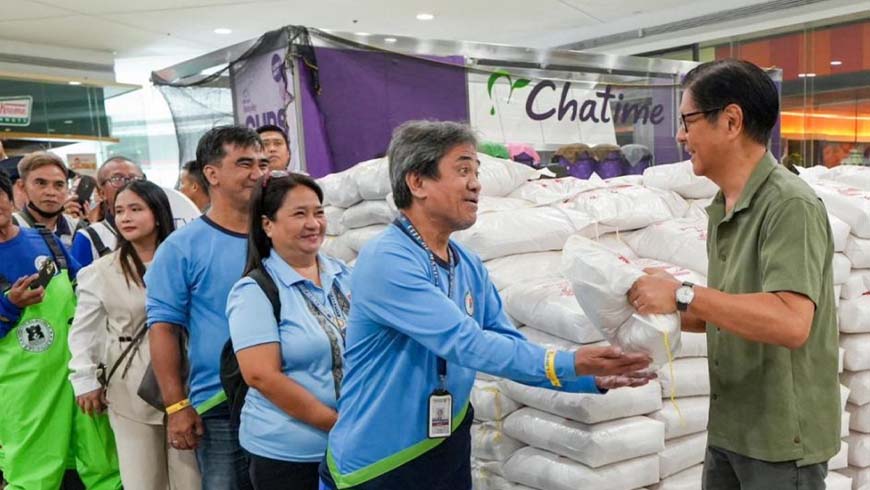
President Ferdinand R. Marcos Jr. personally led the rollout of the government's "Biyayang Bigas" program on Thursday, April 16, distributing 10 kilograms of free rice to workers and low-income residents in Manila as the country continues to grapple with rising petroleum and living costs.
The six-month initiative provides 10 kilos of free rice to 80,000 families, with Manila serving as the first city to implement the program before its nationwide expansion.
During the distribution, President Marcos explained the rationale behind the program and how local governments are being empowered to manage it.
"Ang programang ito ay magbibigay nitong 10 kilo na bigas, anim na beses sa isang taon. At patuloy lang ating binibigay. Binigay na po natin sa ating mga local government para naman ay mabilis. At alam ng local government kasi kung minsan 'yung listahan ng ating mga — dito sa national government, sa mga ahensiya, kung minsan luma na. Sino ba talaga 'yung mga nangangailangan? Sino ba 'yung mga talagang mahihirap na walang makain? Kung minsan 'yung listahan namin medyo nahuhuli," Marcos said.
("This program will provide 10 kilos of rice, six times a year. And we will keep giving. We have already turned it over to the local governments so distribution can be faster. The local governments know better — because sometimes the lists we have at the national level, in the agencies, are already outdated. Who really needs it? Who are the truly poor who have nothing to eat? Sometimes our lists fall behind.")
Not only workers will benefit from the rice distribution, but also poor families.
In Manila, around 80,000 individuals are expected to receive free rice from the government.
The funds allocated for this program come from the Local Government Support Fund or LGSF, sourced from the national government.

Mobile wallet and finance app GCash has extended its zero transfer fee promo for Filipinos sending money to the Middle East until April 30 of this year.
Under the extended offer, no transaction fees will be charged and there is no minimum transfer amount required for remittances to the United Arab Emirates, Saudi Arabia, Qatar, and Oman.
The move was made as a form of relief for Filipinos amid the ongoing tensions in the Middle East.
