%201.svg)


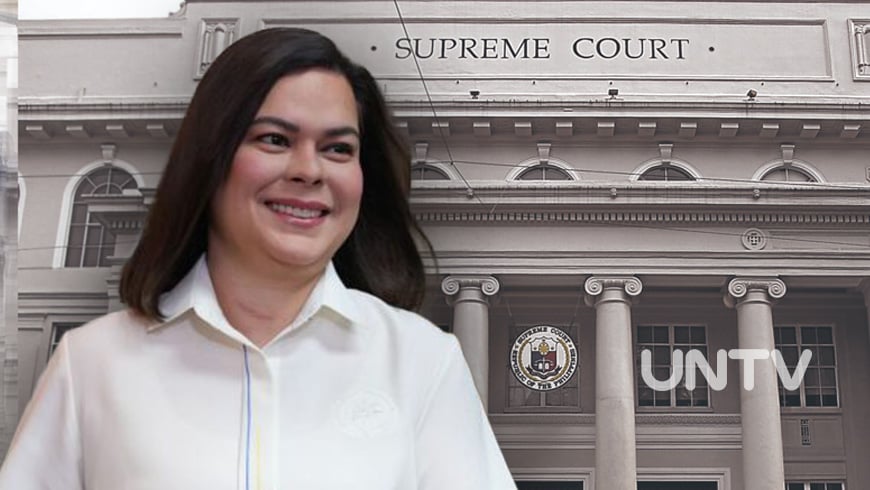
The Supreme Court has clarified in its decision on Vice President Sara Duterte's impeachment case that impeachment is not merely a political matter but a legal and constitutional proceeding that requires due process from the very beginning.
The high court denied the House of Representatives' motion to reverse its declaration that the articles of impeachment against Vice President Duterte were unconstitutional.
The tribunal emphasized that the fourth articles of impeachment submitted to the Senate on February 5, 2025 violated the one-year bar rule.
According to Supreme Court Spokesperson Atty. Camille Sue Mae Ting, the Supreme Court En Banc affirmed that the fourth impeachment complaint transmitted to the Senate on February 5, 2025 was already barred by Article XI, Section 3, subsection (5) of the Constitution.
In the decision written by Senior Associate Justice Marvic Leonen, the court stated that impeachment is a legal, political, and constitutional procedure, not a political proceeding alone.
The court also asserted that under the power granted to them by the Constitution, impeachment proceedings can be reviewed by the judiciary.
The high court stressed that due process must be observed throughout the entire impeachment process, as well as the speedy disposition of cases.
"The due process clause embodies the fundamental constitutional commitment to reasonableness, fairness, and non-arbitrariness. It envisions that we cannot have a true democratic and republican/representative state that is arbitrary and unfair," Ting said.
The House of Representatives can no longer appeal the decision, and the Supreme Court will not accept any other petitions related to the case. This means the ruling is final and cannot be challenged.













.png)
.png)
.png)

.png)