%201.svg)


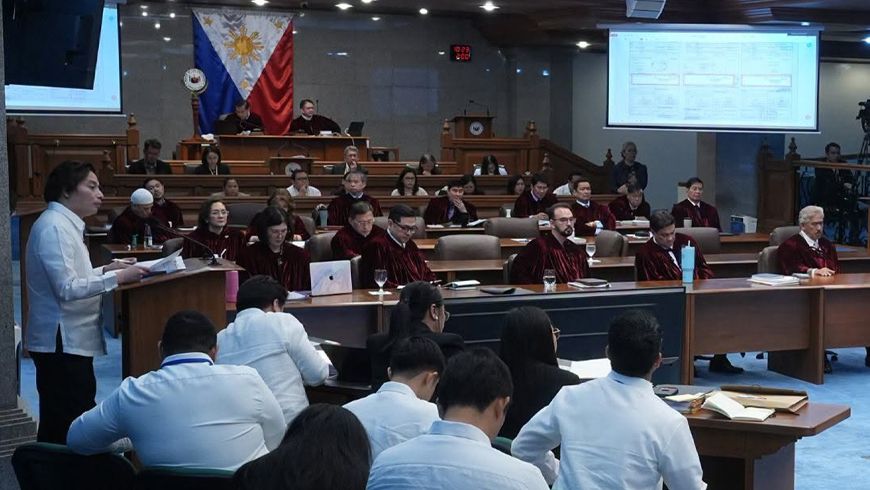
As the impeachment trial of Vice President Sara Duterte continues, viewers following the proceedings are likely to encounter a steady stream of legal and courtroom terminology, from Latin phrases invoked by lawyers to specific audit terms tied to the confidential funds issue at the heart of the case.
Here's a rundown of the terms you'll keep hearing, explained.
1. Presiding Officer
- The Chief Justice or the Senate President who leads and manages the conduct of the impeachment trial.
Source: 1987 Philippine Constitution, Art. XI, Sec. 3(6)
2. House Prosecution Panel
- The group of House of Representatives members who act as prosecutors, presenting evidence and arguments to prove the impeachment charges.
Source: Rules of Procedure in Impeachment Trials, Senate of the Philippines
3. Defense Counsel
- The lawyer or legal team representing the impeachable official, tasked with countering the charges and evidence presented by the prosecution.
Source: Rules of Procedure in Impeachment Trials, Senate of the Philippines
4. Subpoena duces tecum
- A court order requiring a person to appear and bring specific documents or records relevant to the case.
Source: Rules of Court, Rule 21, Sec. 1
5. Subpoena ad testificandum
- A court order requiring a person to appear and testify as a witness, without necessarily bringing documents.
Source: Rules of Court, Rule 21, Sec. 1
6. Ratio decidendi
- The core legal reasoning or principle a court relies on to reach its decision, the binding part of a ruling.
Source: Black's Law Dictionary
7. Obiter dictum
- A remark or observation made by a judge in a decision that is not essential to the ruling and therefore not legally binding.
Source: Black's Law Dictionary
8. Void ab initio
- A Latin term meaning "void from the beginning", describing an act, contract, or law treated as if it never had legal effect.
Source: Black's Law Dictionary
9. Accountable officer
- A government employee or official entrusted with public funds or property and legally responsible for their proper use and disposition.
Source: Government Auditing Code of the Philippines (P.D. 1445)
10. AMLC (Anti-Money Laundering Council)
- The Philippine government body tasked with implementing the Anti-Money Laundering Act, including investigating suspicious financial transactions.
Source: Republic Act No. 9160, as amended
11. Arresto mayor
- A penalty under the Revised Penal Code involving imprisonment ranging from one month and one day to six months.
Source: Revised Penal Code, Art. 27
12. Bank secrecy
- A Philippine law that generally protects the confidentiality of bank deposits, with limited legal exceptions such as court orders in specific cases.
Source: Republic Act No. 1405 (Bank Secrecy Law)
13. Cross-examination
- Questioning of a witness by the opposing party after their initial testimony, used to test, clarify, or challenge their earlier statements.
Source: Rules of Court, Rule 132, Sec. 6
14. Culpable violation of the Constitution
- A willful and intentional breach of the Constitution, not an honest mistake or error in judgment, and one of the grounds for impeachment.
Source: 1987 Philippine Constitution, Art. XI, Sec. 2; UP College of Law Impeachment Primer, 2025
15. Felony
- An act or omission punishable under the Revised Penal Code, committed with deceit (dolo) or fault (culpa).
Source: Revised Penal Code, Art. 3
16. Leading (type of objection)
- An objection raised when a question suggests the desired answer to the witness, typically disallowed during direct examination.
Source: Rules of Court, Rule 132, Sec. 10
17. Objection
- A formal protest raised by a lawyer against a question, evidence, or procedure, asking the presiding officer to disallow it.
Source: Rules of Court, Rule 132
18. Overruled
- A ruling by the presiding officer denying an objection, allowing the question or evidence to stand.
Source: Rules of Court, Rule 132
19. Redirect examination
- Additional questioning of a witness by the party who originally presented them, done after cross-examination to clarify or rebut points raised.
Source: Rules of Court, Rule 132, Sec. 7
20. Sub judice / gag order
- A restriction on public commentary about a case while it is still under court or tribunal deliberation, meant to protect the integrity of proceedings.
Source: Rules of Court; Code of Professional Responsibility and Accountability
21. Sui generis
- A Latin term meaning "of its own kind" — used to describe impeachment as a unique proceeding, distinct from ordinary criminal or civil trials.
Source: Francisco v. House of Representatives, G.R. No. 160261 (2003)
22. Sustained
- A ruling by the presiding officer upholding an objection, disallowing the question or evidence in question.
Source: Rules of Court, Rule 132
23. Ultimate facts
- The essential facts that must be proven to establish a party's cause of action or defense, as opposed to minor evidentiary details.
Source: Rules of Court, Rule 8, Sec. 1
24. Perusing the document
- To read or examine a document carefully before responding or ruling, often said by a judge, senator, or lawyer before commenting on evidence, signaling a close review rather than a quick glance.
Source: Rules of Court, Rule 132 (general evidentiary practice)
25. Prima facie
- Latin for "at first glance" or "on its face" — evidence that appears sufficient to establish a fact or case unless disproven.
A "prima facie case" means there's enough basis to proceed; it is not a final finding of guilt.
Source: Black's Law Dictionary; Rules of Court, Rule 131
26. Notice of Disallowance (ND)
- A formal COA ruling that a government expense or transaction was improper. Only COA's Commission Proper can issue this — a state auditor's observations alone are not final.
Source: 2009 Revised Rules of Procedure of the Commission on Audit
27. Audit Observation Memorandum (AOM)
- A preliminary document noting issues found during an audit. It is different from a formal finding; it flags something for review, not a conclusion of wrongdoing.
Source: COA Circular No. 2009-006
28. Materiality
- Whether a piece of evidence or fact is significant enough to affect the outcome of the case.
Senator-judges may assess if certain documents or testimony are "material" to the impeachment articles.
Source: Rules of Court, Rule 128, Sec. 4
29. Articles of Impeachment
- The formal, written charges against the official being impeached.
Each article represents a specific allegation VP Duterte must answer to during trial.
Source: 1987 Philippine Constitution, Art. XI, Sec. 3
30. Burden of proof
- The obligation to prove a claim or allegation.
This typically rests on the prosecution (House panel) to prove the allegations against VP Duterte.
Source: Rules of Court, Rule 131, Sec. 1


















.png)