


%201.svg)


Emergency Hotline:
(+63) 2 911 – 8688


Navotas City Rep. Toby Tiangco filed a bill in the House of Representatives yesterday seeking to remove the system loss charge from electricity bills currently being paid by consumers.
Under House Bill No. 10273, or the proposed System Loss Charges Abolition Act of 2026, Tiangco stressed that consumers should not have to shoulder costs arising from inefficiencies or losses that are beyond their control.
The lawmaker added that while current law allows distribution utilities to recover system loss costs, the continuing increase in electricity rates only shows a lack of protection for consumers.
President Ferdinand Marcos Jr. earlier said in his recent State of the Nation Address that customers should not be made to shoulder the obligation of paying for system loss, since they have no responsibility for it.
Manila, Philippines – The Bureau of Internal Revenue (BIR) has expressed full readiness to carry out the tax reform initiatives outlined by President Ferdinand R. Marcos Jr., according to Commissioner Charlito Mendoza.
Marcos raised the tax reform push during his fifth State of the Nation Address this week, where he pushed for relief measures designed to spur economic growth, boost government revenue, and promote fairness in the country's fiscal system.
Among the proposals are a wider income tax exemption bracket and the removal of minimum corporate income tax for small businesses.
Mendoza said the agency backs the President's direction and is prepared to carry out whatever version of the measures Congress eventually passes.
"The BIR supports this direction and stands ready to faithfully and efficiently implement the measures that Congress may enact," he said in a statement.
He added that the bureau's focus now is on internal readiness so that it can act swiftly once the reforms become law.
"Our responsibility now is to ensure that the Bureau is fully prepared once these measures are signed into law, while sustaining our ongoing initiatives to strengthen tax administration and enhance taxpayer experience," Mendoza added.
While Congress deliberates on the legislation, Mendoza said the BIR will not wait idly — the agency plans to push forward with reforms already within its own mandate.
These include strengthening compliance sampling, upgrading taxpayer services, modernizing its digital systems, and reviewing outdated internal processes and regulations.
He also committed to keeping communication open with various stakeholders to make sure future BIR policies stay aligned with taxpayers' actual concerns.
Mendoza said these combined efforts are meant to ensure a smooth rollout of any relief measures once implemented.
"Through these efforts, we will help ensure that tax relief measures are implemented efficiently, encourage greater voluntary compliance, and continue generating the revenues needed to fund essential public services," he said.

The Bureau of Internal Revenue (BIR) has submitted the tax records of Vice President Sara Duterte to the Senate, meeting the deadline set by the Senate Impeachment Court for the submission of the documents today, Thursday, July 30.
Along with the Vice President's tax records, bank records and Anti-Money Laundering Council (AMLC) records of Duterte and her husband, Atty. Manases Carpio, were also submitted.
Bicol Saro Partylist Rep. Terry Ridon, a member of the House prosecution panel, confirmed the submission and stated that President Ferdinand Marcos issued the authorization for the release of the particular tax records.
"Naglabas si Pangulong Ferdinand Marcos ng authorization para sa release ng partikular na tax records [ni Vice President Sara Duterte]." Ridon confirmed.
[President Ferdinand Marcos issued the authorization for the release of the particular tax records [of Vice President Sara Duterte].]
These documents are being presented as evidence for the article of impeachment concerning unexplained wealth, or the alleged wealth of the Vice President that has not been accounted for.
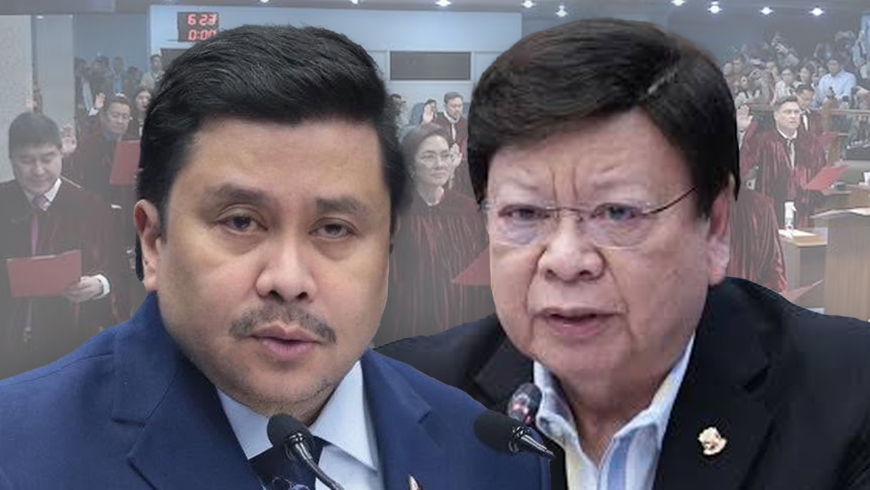
The Senate has yet to tackle the issue on whether Senators Rodante Marcoleta and Jinggoy Estrada will be allowed to attend the impeachment trial of Vice President Sara Duterte.
According to Senate leadership, they have not yet received any formal request from the two senators' camp regarding this matter.
Despite the request to be allowed to attend the impeachment trial of Vice President Sara Duterte, Senate President Sherwin Gatchalian said they have not received any formal request from the side of Senator Rodante Marcoleta and Senator Jinggoy Estrada on this matter.
"Wala namang formal request sa Senate. Maski sa akin wala namang formal request. Sa conversation na lumalabas sa iba't ibang fora.. But formally, wala naman. Well, naririnig lang natin" SP Gatchalian said.
[There's no formal request to the Senate. Even to me, there's no formal request. It's in the conversations happening in different forums.. But formally, there's none. Well, we just hear about it.]
However, the Senate President confirmed that he received a letter, but it did not state anything about how the two senators could take part in the impeachment trial.
"Yes, may letter siya addressed sa akin, but wala naman na explicit doon na nakasulat na may request for... parang formal request kung paano siya magpaparticipate. Wala namang ganun. So ang kanyang letter is about his opinion on the presiding officer, as well as yung opinion niya dun sa 16 votes." Gatchalian added.
[Yes, he has a letter addressed to me, but there's nothing explicit written there about a request for... like a formal request on how he could participate. There's nothing like that. So his letter is about his opinion on the presiding officer, as well as his opinion on the 16 votes.]
Because of this, SP Gatchalian said they have not yet taken any action or even response on this matter.
He again emphasized that if a senator is suspended, he really cannot participate in the trial.
He said that along with the suspension as senator comes the suspension of his other duties, such as being a senator-judge.
Meanwhile, for Senator Imee Marcos, she hopes their colleagues in the minority will be allowed to attend even just virtually, while they are in detention.
"Ayun nga, ayun nga, ang kinukulit namin kasi mahalaga sa amin na kasama sila. Parang hindi pa nasa sentensyahan hindi pa klaro." the Presidential sister stated.
[That's right, that's right, that's what we keep pushing for because it's important to us that they're included. It seems like it's not yet at sentencing, it's not yet clear.]
As of now, even the Senate Impeachment Court itself has not released any details regarding the issue.
But Senator-Judge Alan Peter Cayetano had earlier suggested asking the Sandiganbayan about the participation of the two senators in the trial.
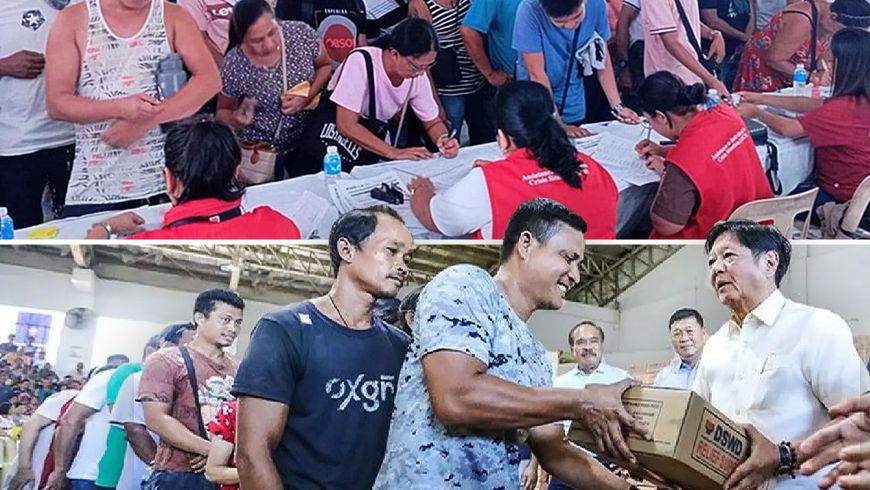
"Ayuda" is the Filipino term for government cash or in-kind assistance given to citizens, usually during economic hardship, disasters, or health crises. In principle, ayuda serves as a social safety net — it's meant to help families cover immediate needs like food, transportation, medicine, and utilities when their income can't keep up with rising costs.
Programs like the Pantawid Pamilyang Pilipino Program (4Ps) and TUPAD (Tulong Panghanapbuhay sa Ating Disadvantaged/Displaced Workers) have long been credited with helping vulnerable households survive short-term shocks.
But behind that safety net lies a more complicated question, one that resurfaces almost every time a new aid program rolls out: who actually benefits when the government hands out cash?
Ayuda funds come from the national budget specifically, appropriations passed through Congress and administered by agencies like the Department of Social Welfare and Development (DSWD).
Because these programs put money directly and visibly into people's hands, they've also become useful tools for politicians looking to build public goodwill.
Sponsoring, endorsing, or personally distributing aid gives a lawmaker or local official direct, tangible credit with constituents — which is part of why ayuda proposals are so frequently attached to a specific name.
Does receiving ayuda affect how Filipinos vote?
This is a widely discussed, though hard-to-measure precisely, dynamic in Philippine politics.
Analysts and critics have long pointed out that government funds intended for the poor are often used by politicians as a form of political patronage, with the expectation that beneficiaries will remember who provided the aid come election time.
Studies and policy critics note that ayuda programs are often entangled with patronage politics, with implementation frequently "compromised by political favoritism and electoral manipulation."
In September 2022, the Commission on Elections ruled that then-Legazpi City Mayor Noel Rosal violated Section 261 of the Omnibus Election Code when he distributed financial assistance to tricycle drivers on March 31, 2022 and to senior citizens on April 2, 2022 within the 45-day election spending ban ahead of the May 2022 polls.
The case stemmed from a disqualification petition filed by a defeated city council candidate, Joseph Armogila, against Rosal, who was running for governor at the time. The Comelec found that the cash payout was not an exempted activity and ruled that Rosal had violated the election code.
Rosal's wife, then-Legazpi City Mayor Carmen Geraldine Rosal, was also disqualified by a separate Comelec division for her involvement in the same payout event, with the poll body ruling that her presence during the distribution "rendered moral assistance to the Local Government Unit."
The Supreme Court later affirmed both disqualifications in October 2024, upholding that the couple violated the Omnibus Election Code's prohibition on the disbursement and release of government funds during the prohibited period before a regular election.
Separately, the Commission on Audit also upheld findings holding the Rosal couple accountable for irregular cash aid payouts totaling ₱64.7 million in 2022, including funds disbursed as financial assistance to tricycle drivers and senior citizens.
This case is one of the clearest documented instances of cash assistance intersecting directly with election law in the Philippines.
Why do some Filipinos depend on ayuda?
Poverty and economic precarity are widely cited as major drivers of continued reliance on ayuda programs, particularly during crises like the COVID-19 pandemic and, more recently, the fuel price increases linked to Middle East tensions.
Critics and policy analysts have argued that repeated, election-adjacent cash handouts risk treating symptoms of poverty rather than addressing root causes like jobs, education, and healthcare access — though this remains a matter of policy debate rather than settled empirical consensus.
Where did the term "ayuda politics" come from?
The phrase has emerged gradually in Philippine political commentary and journalism over the past several years, gaining traction especially around election cycles and controversial aid rollouts, including the 2025 controversy surrounding AKAP (Ayuda para sa Kapos ang Kita Program), and the long-running dispute over Senator Alan Peter Cayetano's proposed ₱10,000 assistance for Filipino families.
It is not an official government term; it is shorthand used by analysts, journalists, and critics to describe the recurring entanglement of welfare programs with electoral and patronage politics.
So, what exactly is "ayuda politics"?
At its core, ayuda politics refers to the practice and criticism of using government cash assistance programs as tools of political patronage rather than purely need-based welfare. It covers behaviors like politicians timing aid rollouts near elections or publicizing aid distribution to build political visibility — the kind of conduct at the center of the Rosal case above.
Could this affect the 2028 national elections?
It's a question some political observers have raised, given UPLIFT's rollout roughly two years ahead of the 2028 presidential election.
No evidence currently confirms an intent to time UPLIFT for electoral purposes, but the underlying concern has precedent in the Philippines' own experience with cash aid programs.
In the case of the Pantawid Pamilyang Pilipino Program (4Ps) — the country's flagship conditional cash transfer program, implementation stalled from early to late 2010, in principle to avoid political manipulation in the distribution of cash transfers during that year's election season, according to Philippine government records cited in an academic study.
A separate peer-reviewed study specifically examined whether 4Ps beneficiaries rewarded the party that enacted the program or the party in power at the time of the following election, using the 2010 Philippine municipal elections as its case study.
Philippine-focused research on the politics of cash transfer programs has also found that poverty reduction programs are widely recognized as effective instruments for producing electoral rewards, making them generally appealing to Filipino politicians, though programs with stronger control and accountability mechanisms tend to carry lower risk of political manipulation.
Has the government addressed "ayuda politics" concerns directly?
President Ferdinand Marcos Jr. declared, upon signing the 2026 national budget, that politicians would be barred from participating in the distribution of financial assistance, a move aimed at curbing patronage in welfare programs.
Marcos also directed the DSWD to take the lead in non-partisan distribution of funds, in an effort to insulate assistance programs from political interference. Whether this policy holds up in practice, particularly at the local level, where the Rosal case originated, has not yet been independently verified through subsequent audits or rulings specific to UPLIFT.
A throwback: the ₱10,000 ayuda that never came
UPLIFT's rollout has also revived an older, unresolved promise.
Senator Alan Peter Cayetano first filed a bill in 2022, dubbed the "Sampung Libong Pag-asa Law," proposing ₱10,000 per family or ₱1,500 per family member in COVID-era cash assistance. That proposal never became law; it stalled in Congress in 2021, before Marcos even assumed the presidency in mid-2022, and was excluded from the 2022 national budget.
In July 2026, following UPLIFT's rollout, Cayetano claimed in a Facebook livestream that PBBM had rejected his proposal after winning the 2022 election, despite the government having the budget to fund it.
Meanwhile, Palace Press Officer Claire Castro said there was nothing for Marcos to reject, since Cayetano's measure had already failed to advance in Congress before Marcos took office, and urged the senator to "own up to his own shortcomings" rather than pin the blame on others.
So, who really benefits from Ayuda?
Ayuda is supposed to be a lifeline, not a leash.
But history shows how easily a public safety net can be bent into a private campaign tool, disbursed on a politician's timeline instead of a family's need.
Every peso of ayuda answers two questions at once — does it reach the family that needs it, and does it serve the politician who made sure they saw who sent it?
Philippine history proves both can happen under the same program. UPLIFT says this time will be different.
But until poverty itself is addressed at its roots, not just cushioned every election cycle, Filipinos will keep facing the same choice: take the help in front of them, or wait for a government that no longer needs ayuda to prove it cares.
