


%201.svg)


Emergency Hotline:
(+63) 2 911 – 8688


MANILA — The Department of Health is urging the public to recognize the warning signs of heat-related illnesses as a strong El Niño raises the risk of hotter and drier conditions in the country.
The DOH warned that heat stroke is a medical emergency that requires immediate attention.
Signs may include loss of consciousness, very high body temperature, difficulty breathing, confusion or difficulty communicating, slurred speech and convulsions.
Anyone showing signs of heat stroke should be brought immediately to the nearest health facility or assistance should be sought through the National Emergency Hotline 911, according to the health department.
The public is also advised to watch for heat exhaustion, which may develop before a more serious heat-related illness.
Symptoms include extreme fatigue or weakness, dizziness, muscle cramps, nausea and excessive sweating.
To reduce the risk of heat-related illness, the DOH advises people to wear light-colored and lightweight or breathable clothing, stay hydrated and limit strenuous physical activity during the hottest periods of the day.
DOH information materials generally recommend drinking around eight to 10 glasses of water daily to maintain hydration during hot conditions.
The warning comes as PAGASA monitors an intensifying El Niño in the tropical Pacific.
The state weather bureau said a strong El Niño is currently active and is expected to strengthen into a very strong El Niño between September and December 2026. Climate models indicate that the phenomenon could persist through the first half of 2027.
El Niño increases the likelihood of below-normal rainfall and may contribute to dry spells and drought in parts of the Philippines.
With hotter conditions expected in the coming months, health officials are reminding the public not to ignore symptoms associated with prolonged exposure to heat.
PUBLIC REMINDER:
Heat exhaustion and heat stroke are not the same. Symptoms such as weakness, dizziness, cramps and heavy sweating may signal heat exhaustion, while loss of consciousness, confusion, very high body temperature or convulsions require urgent medical attention.

MANILA — The southwest monsoon or Habagat season has officially ended, marking the end of the rainy season over the western sections of Luzon and Visayas, PAGASA announced Monday.
The state weather bureau said recent observations showed a gradual shift in the country’s prevailing weather pattern. PAGASA officially posted its Termination of the Southwest Monsoon advisory on October 5.
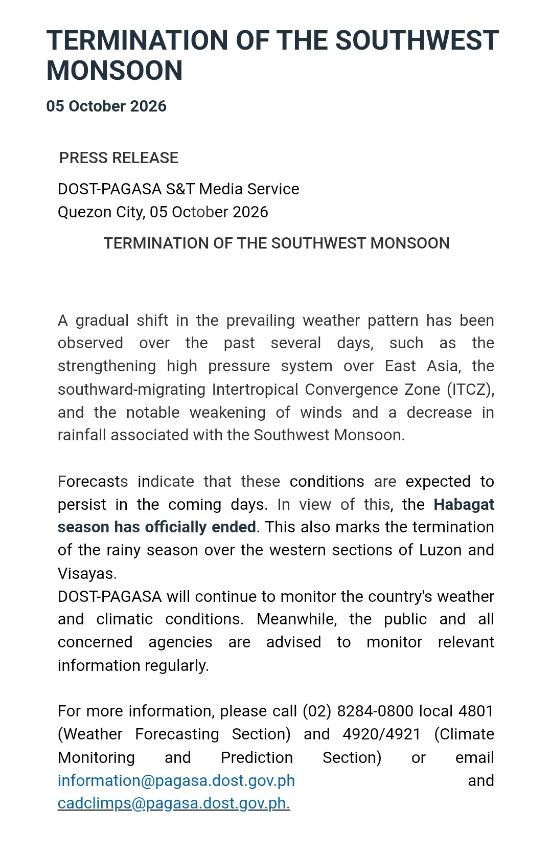
Among the changes observed were the strengthening of the high-pressure system over East Asia and the southward movement of the Intertropical Convergence Zone or ITCZ.
PAGASA also noted a significant weakening of southwesterly winds and a decrease in rainfall associated with the Habagat.
The southwest monsoon season began on May 30, when PAGASA observed the establishment of southwesterly winds over the western portion of the country.
Days later, on June 4, the weather bureau declared the onset of the rainy season over western Luzon and Visayas after several days of frequent rains associated with the Habagat.
The latest announcement therefore ends both the 2026 Habagat season and the rainy season for those areas.
The declaration, however, does not mean that rainfall will completely stop. Other weather systems, including tropical cyclones, the ITCZ, easterlies and localized thunderstorms, may still bring rain to different parts of the country.
PAGASA said it will continue monitoring weather and climate conditions and advised the public to keep track of official weather updates.

MANILA — P-pop group SB19 is bringing Filipino talent to the regional stage as the voice behind “Together in Motion,” the official ASEAN 2026 song released by Tourism Philippines.
https://www.youtube.com/watch?v=sbI1csvW2i8
The Department of Tourism unveiled the track through Tourism Philippines, describing SB19 as the group “bringing it to life” as part of the Philippines’ ASEAN chairship this year.
“Together in Motion” was composed by Anya Lagman and arranged by Jimmy Antiporda and Louie Ocampo.
The song reflects the Philippines’ ASEAN 2026 chairship theme, “Navigating Our Future, Together,” which emphasizes regional cooperation, unity and shared progress among Southeast Asian nations.
Its music video features scenes representing ASEAN member states, highlighting landscapes, cultures and shared regional identity across Southeast Asia.
SB19’s participation also ties into the group’s role as Philippine tourism ambassadors. The Department of Tourism named SB19 among the country’s tourism ambassadors earlier this year as part of efforts to promote the Philippines and its culture to a wider international audience.
The release comes as the Philippines continues its chairship of ASEAN in 2026. The country has hosted meetings throughout the year under the theme “Navigating Our Future, Together,” with priorities covering peace and security, prosperity and people empowerment.
“Together in Motion” adds a contemporary P-pop sound to the Philippines’ ASEAN campaign, with SB19 representing the country in a project centered on regional unity and cooperation.
The song and its music video are now available through Tourism Philippines’ official online platforms.

MANILA – Nearly 400,000 people have been affected by El Niño as damage to agriculture climbed to more than ₱5.4 billion, according to the latest figures from the Office of Civil Defense.
The OCD reported 388,375 affected individuals across 893 barangays in four regions, as prolonged dry conditions continue to hit communities and livelihoods.
Caraga recorded the largest affected population, with 291,381 people in 140 barangays. Bicol followed with 49,216 individuals in 39 barangays, while Cagayan Valley recorded 47,587 affected people across 714 barangays. Calabarzon reported 191 affected individuals.
The agriculture sector has absorbed much of the impact.
OCD figures showed 199,857 farmers and fisherfolk affected, with production losses reaching 112,862.46 metric tons. The estimated value of agricultural damage stood at ₱5.469 billion.
Cagayan Valley accounted for the bulk of the reported losses, with ₱4.968 billion in agricultural damage and about 93,343 metric tons in production losses. More than 194,000 farmers and fisherfolk in the region were affected.
Damage was also reported in Davao Region, Bicol, Calabarzon, Soccsksargen and Caraga.
The continuing dry conditions have prompted 106 cities and municipalities to declare a state of calamity.
Of the total, 66 are in Cagayan Valley, 23 in Caraga, 12 in Bicol, four in Calabarzon and one in Soccsksargen. Caraga has also recorded 39 wild, forest or mountain fire incidents amid the dry conditions.
The national government has so far provided more than ₱39 million in assistance to affected communities in Cagayan Valley, Bicol and Caraga.
The figures come as the country prepares for a potentially more severe phase of El Niño.
PAGASA said a strong El Niño is already active in the tropical Pacific and is expected to intensify into a very strong El Niño before the end of 2026.
The state weather bureau warned that the phenomenon could persist through the first half of 2027.
El Niño increases the likelihood of below-normal rainfall and can lead to dry spells and drought in parts of the country, although PAGASA noted that some western areas may still experience above-normal rainfall during periods influenced by the southwest monsoon.
PAGASA has urged climate-sensitive sectors and government agencies to prepare as the phenomenon intensifies.

MANILA — Senate impeachment court presiding officer Francis “Chiz” Escudero on Monday reminded participants in Vice President Sara Duterte’s impeachment trial to maintain civility as tensions continue to rise during the proceedings.
Escudero issued the reminder at the start of Day 33 of the trial on October 5, acknowledging that patience was wearing thin and tempers were beginning to fray.
He stressed, however, that the prosecution, defense and other participants should remain focused on assisting the impeachment court in the fair and orderly administration of justice.
Escudero cited the Code of Professional Responsibility and Accountability, which requires lawyers to treat fellow members of the legal profession with courtesy, civility, fairness and candor.
He also invoked the words of former United States Supreme Court Justice Sandra Day O’Connor on the importance of professionalism within the justice system.
“Patience is wearing thin, tensions are running high, and tempers are beginning to fray,” Escudero said.
The presiding officer said disagreements and criticism may remain vigorous, but arguments during the proceedings should not become personal or degrading.
Escudero added that the impeachment court would remain focused on deciding the case based on the evidence and the requirements of fairness and justice, regardless of statements or criticism coming from inside or outside the courtroom.
His remarks came as the impeachment trial entered its 33rd day, with the court continuing its hearings under Article II of the impeachment complaint.
On Monday, the court was also set to hear testimony from Anti-Money Laundering Council Executive Director Ronel Buenaventura concerning covered and suspicious transaction reports involving the Vice President, her husband Manases Carpio and several juridical entities.
The allegations under Article II involve alleged unexplained wealth, false asset declarations and continued business interests. Vice President Duterte has denied wrongdoing and is contesting the impeachment charges.
