


%201.svg)


Emergency Hotline:
(+63) 2 911 – 8688




MANILA, Philippines — A new wage order granting a ₱60 daily minimum wage increase to private-sector workers in Metro Manila has been approved by the regional wage board as the implementation of an earlier ₱85 wage hike remains stalled by a court injunction.
The Regional Tripartite Wages and Productivity Board-National Capital Region (RTWPB-NCR) approved Wage Order No. 28 on September 7 and has forwarded it to the National Wages and Productivity Commission (NWPC) for review and confirmation, according to the Department of Labor and Employment (DOLE).
DOLE-NCR Regional Director Roy Buenafe said that if the NWPC affirms the order, it could be published by September 11 and take effect by September 26 or 27.
The new order provides a one-time ₱60 increase.
Labor Secretary Francis Tolentino clarified that the amount should not be interpreted as a deduction from the ₱85 increase provided under the earlier Wage Order No. 27, which has been caught in a legal dispute.
Wage Order No. 27 provided for an ₱85 daily minimum wage increase in Metro Manila, consisting of a ₱60 first tranche and another ₱25 increase scheduled later. Its implementation, however, was halted following court action challenging the order.
Tolentino said the regional wage board moved to issue Wage Order No. 28 to provide additional income to workers while the legal dispute over the previous order remains unresolved.
The new wage order was disclosed during the House Committee on Appropriations' hearing on DOLE's proposed ₱47.057-billion budget for 2027 on Sept. 8.
Marikina 2nd District Rep. Miro Quimbo welcomed the wage board's move, saying workers continue to face financial pressure while the previous wage order remains under injunction.
If affirmed by the NWPC and allowed to take effect, Wage Order No. 28 would provide the ₱60 wage adjustment independently of the unresolved legal proceedings involving Wage Order No. 27.

MANILA, Philippines — The government is targeting nearly 40,000 active free public internet access points nationwide in 2027 as it proposes ₱53.1 billion for information and communications technology and digitalization initiatives.
Under the proposed 2027 National Expenditure Program, the number of active free public internet access points is targeted to reach 38,829, up by 15,913 from the 22,916 targeted for 2026. This represents an increase of nearly 69 percent.
The expansion will be supported by the ₱5-billion Free Public Internet Access Program, according to the Department of Budget and Management (DBM).
The government is also targeting 14,969 covered public locations and connectivity in 1,634 localities nationwide.
Priority areas include geographically isolated and disadvantaged communities, remote barangays, public schools, healthcare facilities and transport hubs.
President Ferdinand Marcos Jr., in his 2027 budget message, said expanding reliable connectivity is intended to bring government services, education, healthcare and economic opportunities closer to Filipinos regardless of location.
Apart from expanding internet access, the proposed budget seeks to put more government services online and improve the integration of government information systems.
Funding for the eGovernment Program is proposed to increase to ₱3.23 billion in 2027 from ₱1.49 billion under the 2026 national budget.
The National Government Data Center Infrastructure, meanwhile, is proposed to receive ₱950 million, while ₱312 million is being sought for the National Government Portal.
The government is also proposing ₱1.1 billion for the National Broadband Program, up from ₱667 million in 2026, and ₱2.16 billion for the Philippine Digital Infrastructure Project.
These initiatives are aimed at strengthening digital platforms such as eGovPH and making government transactions more accessible and efficient.
DBM Acting Secretary Kim Robert de Leon said reliable digital infrastructure is necessary for an efficient government and for expanding access to education and economic opportunities.
Of the proposed ₱53.1-billion government-wide ICT and digitalization expenditures, the Department of Information and Communications Technology is set to receive ₱14.4 billion in ICT-related spending, the largest share among national government agencies.
The proposed budget also includes ₱722 million for the DICT's ICT Capacity and Industry Ecosystem Development and Management Program.
This includes ₱143 million for workforce upskilling and reskilling and ₱193 million for Digital Transformation Centers.
The programs are expected to support training in areas such as data analytics, cybersecurity, digital marketing and emerging technologies, including artificial intelligence and machine learning.
The allocations are part of the proposed 2027 national budget and remain subject to congressional deliberations and approval.
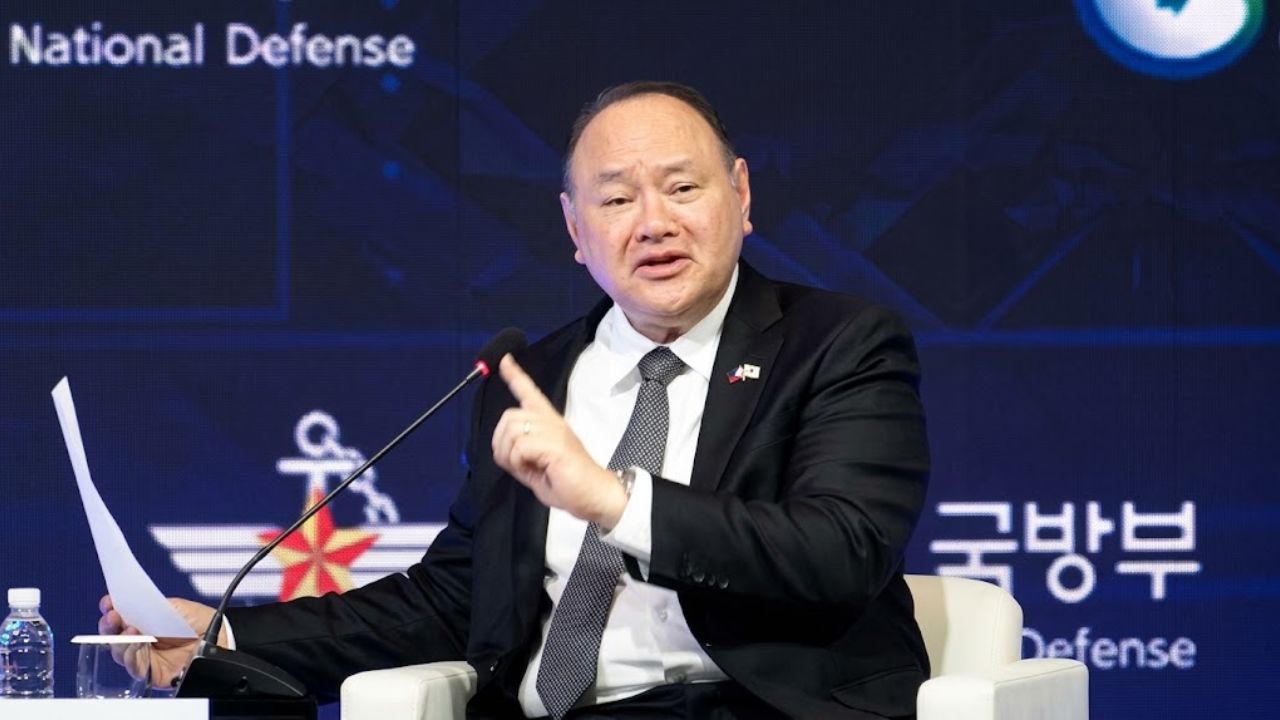
MANILA, Philippines — Defense Secretary Gilberto Teodoro Jr. pushed back against China after receiving a handwritten note defending Beijing’s rejection of the 2016 South China Sea arbitral ruling while he was speaking at an international defense forum in Seoul, South Korea.
Teodoro was participating in a panel discussion at the 2026 Seoul Defense Dialogue on Tuesday, Sept. 8, when a forum staff member handed him the note as he discussed maritime security, China’s actions in the South China Sea, and the importance of complying with the United Nations Convention on the Law of the Sea or UNCLOS.
The note stated that China’s position on the South China Sea arbitration remained “clear, consistent and firm” and repeated Beijing’s position that the arbitral award was illegal, null and void and had no binding force.
Teodoro read portions of the note aloud and challenged its assertions.
When the note said China neither accepts nor recognizes the arbitral ruling, Teodoro responded, “Of course, because you lost.”
He also criticized the manner in which the message was delivered during the international forum, describing the incident as disrespectful to international law and the rules-based order.
Teodoro said China’s actions in the South China Sea should no longer be treated merely as “gray zone” tactics, describing them instead as coercion, bullying and aggression.
According to Seoul Defense Dialogue organizers, the handwritten note came from a Chinese military attaché assigned to the Chinese Embassy in Seoul. The attaché reportedly gave the note to a forum staff member and asked that it be passed to Teodoro.
Organizers said the staff member mistakenly thought the note came from the Philippine delegation and handed it to Teodoro while he was speaking.
The 2016 arbitral award rejected the legal basis for China’s sweeping historic-rights claims within its so-called nine-dash line in the South China Sea. The tribunal also upheld several of the Philippines’ maritime entitlements under UNCLOS.
China did not participate in the arbitration and continues to reject the ruling.
The award is final and binding on the Philippines and China under the dispute-settlement provisions of UNCLOS, although the tribunal has no enforcement mechanism of its own.

MANILA, Philippines — Talent can open the door, but for young athletes, getting the chance to compete often requires something more: consistent support.
The story of young chess player Bince Rafael Operiano of Oas, Albay is one example.
Operiano caught national attention after representing the Philippines at the 6th Eastern Asia Youth Chess Championship in Bangkok, Thailand in November 2022.
Then only eight years old, according to a Senate resolution recognizing his achievement, Operiano emerged champion in the tournament after qualifying through the Boys Under-9 category of the National Youth and Schools Chess Championships Grand Finals in Dapitan City.
His talent had already been evident at an early age. His chess skills drew attention after he won the National Age Chess Group Championship-Kiddie Category in Albay when he was six.
But reaching an international tournament was not simply a matter of winning matches.
Operiano came from a family with limited financial resources. His father, Ben Operiano, worked as a security guard and was the family's breadwinner. Ahead of the Bangkok competition, the family sought financial assistance to cover travel and other expenses.
Reports at the time said Bince and his father spent several nights on airport benches while waiting for travel arrangements. Bince eventually traveled to Thailand ahead of his father and began the competition without a parent beside him.
Despite those circumstances, he went on to bring home international recognition for the Philippines.
The Senate later formally commended Operiano for his victory, describing his achievement as an example of the talent and potential of young Filipino athletes.
His chess journey did not end with that breakthrough.
Records from the Philippines Chess Federation's 2026 National Youth and Schools competitions show Operiano continuing to represent Oas, Albay in the Under-13 division. In the national rapid championship held in March, he finished with four points and placed eighth among the competitors.
Bince's experience highlights a challenge that extends beyond chess: promising young athletes may have the ability to compete, but training, transportation, tournament fees, equipment and accommodation can become barriers for families with limited resources.
Support can come from different sectors, parents and communities who nurture young athletes, schools that provide opportunities to compete, sports organizations that develop talent, and public and private institutions that help qualified athletes reach higher-level competitions.
For aspiring young athletes, Bince's story is also a reminder that development takes years. International success may begin with talent, but staying competitive requires continued training, discipline and access to opportunities.
Years after his breakthrough in Bangkok, the young chess player from Oas remains active on the board — continuing a journey that began with local competitions and grew into an opportunity to represent the Philippines.
.png)
MANILA, Philippines – The Department of Education (DepEd) may not be able to hire 14,274 additional teachers in 2027 if funding for new teaching positions is not restored, as the agency faces funding gaps across several priority programs under the proposed national budget.
During the House Committee on Appropriations hearing on DepEd’s proposed 2027 budget, Education Secretary Sonny Angara said some of the department’s targets may not be met if current funding levels are maintained.
Among the affected areas is infrastructure.
Based on the proposed 2027 budget, only ₱32.33 billion is allocated for DepEd’s infrastructure capital outlay, significantly lower than the ₱99.47 billion provided in 2026.
The department is also seeking additional funding for the School-Based Feeding Program. Its proposed allocation dropped to about ₱11 billion from roughly ₱26 billion previously.
The Academic Recovery and Accessible Learning or ARAL Program also received no allocation under the 2027 National Expenditure Program despite DepEd’s request for around ₱16 billion.
Funding for Special Needs Education or SNED also fell short of the department’s request. DepEd sought about ₱1.39 billion, but only ₱849.9 million was included in the proposed allocation, leaving a gap of roughly ₱541 million.
Personnel requirements are also among DepEd’s funding concerns. The proposed 2027 budget carries no allocation for 14,274 new teaching positions, which would require around ₱4.29 billion.
DepEd included these and other requirements in a broader request for roughly ₱145 billion in additional funding.
However, the House Committee on Appropriations said the entire amount may not be accommodated.
Committee chairperson Rep. Mikaela Suansing asked DepEd to submit a new prioritized, streamlined and rationalized list of programs and projects, estimated at around ₱20 billion, ahead of plenary deliberations.
Suansing said the House is working under a tight schedule as the proposed budget is expected to reach plenary deliberations the following week. She asked DepEd to submit the revised list by Wednesday noon for review.
The new list is expected to focus on the department’s most urgent needs, including catching up on targets for teachers and classrooms, as well as programs that directly affect learners.
Angara welcomed the request and thanked lawmakers for efforts to consider additional funding for the department.
The reprioritized list will serve as one of the bases for lawmakers in determining which DepEd programs may receive additional funding before the proposed 2027 budget proceeds to plenary deliberations.
It remains to be seen whether the requested funding for 14,274 new teachers will be retained among DepEd’s highest priorities in the revised list.
