


%201.svg)


Emergency Hotline:
(+63) 2 911 – 8688


MANILA – Mamamayang Liberal party-list Rep. Leila De Lima was named the new House senior deputy minority leader on Tuesday, replacing Caloocan City Rep. Edgar Erice.
House Minority Leader Marcelino Libanan moved to replace Erice and nominate De Lima during the regular House session. The motion was joined by the majority bloc, as manifested by House Deputy Majority Leader Ronald Singson of Ilocos Sur.
The leadership change came on the same day that Erice publicly criticized President Ferdinand Marcos Jr. and his allies in the House for what he described as taking the public for a ride over the Anti-Political Dynasty bill, which he said was being falsely presented as a legislative priority.

MANILA – President Ferdinand R. Marcos Jr. on March 3 welcomed South Korean President Lee Jae Myung at Malacañang Palace for a two-day state visit focused on strengthening bilateral ties in defense, maritime security, and economic relations.
Marcos and FL Liza Marcos accorded arrival honors to Lee at the Kalayaan Grounds. The South Korean leader was accompanied by First Lady Kim Hea Kyung.
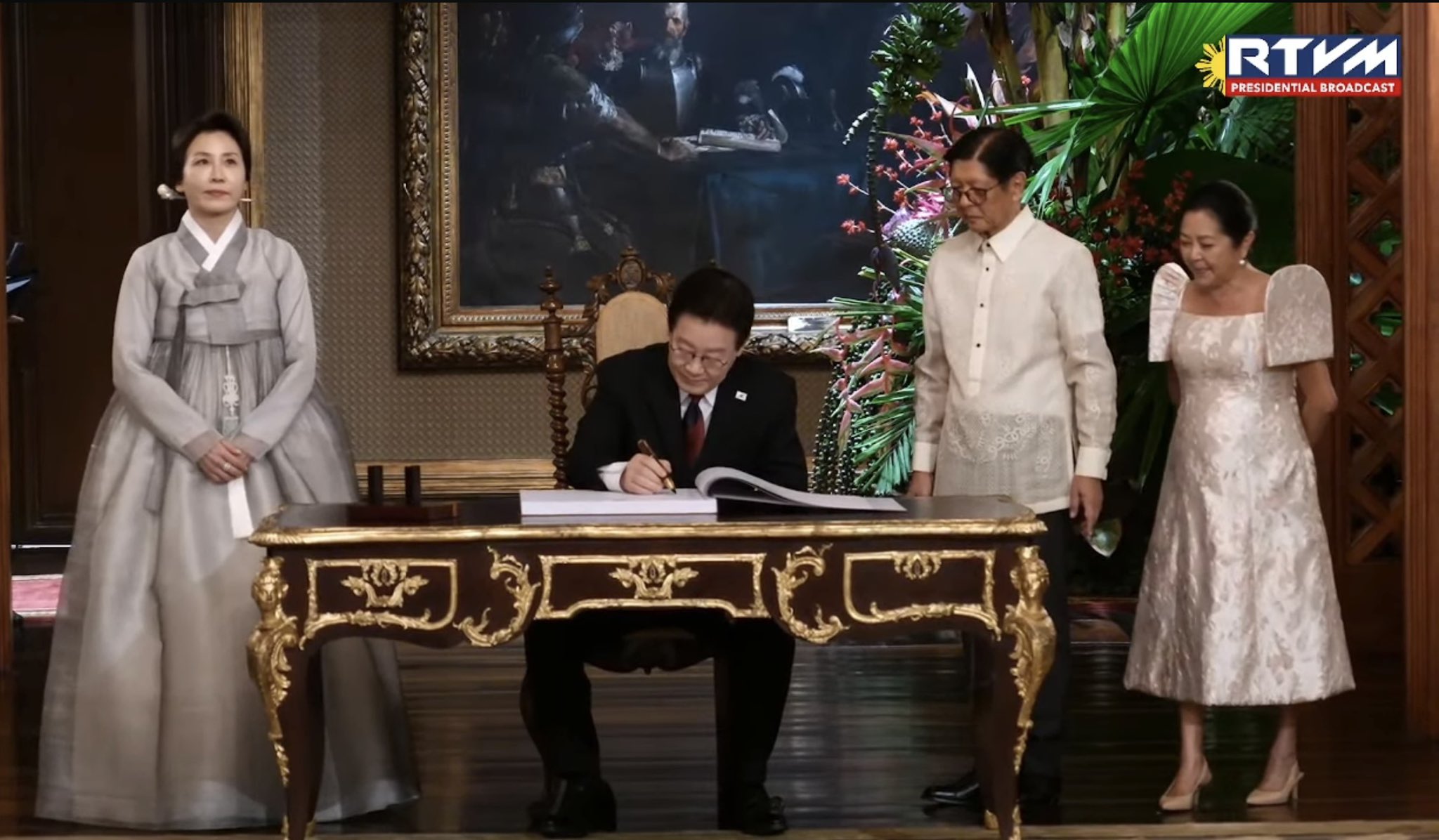
The visit marks the first by a South Korean head of state to the Philippines since the Philippines-Republic of Korea Free Trade Agreement took effect on December 31, 2024.
Following the welcome ceremony, Lee signed the Palace guestbook before proceeding to a bilateral meeting with Marcos. Key Cabinet members joined the Philippine side, including Trade Secretary Cristina Aldeguer-Roque, Finance Secretary Frederick Go, Economic Planning Secretary Arsenio Balisacan, Interior Secretary Juanito Victor Remulla, Executive Secretary Ralph Recto, Education Secretary Sonny Angara, Agriculture Secretary Francisco Tiu-Laurel Jr., National Security Adviser Eduardo Año, and Presidential Communications Secretary Dave Gomez.
The two leaders are expected to discuss enhanced collaboration in defense and maritime security amid evolving regional and global security dynamics, as well as the broader implications of rising Middle East tensions on energy markets and supply chains.
After the bilateral talks, Marcos and Lee are scheduled to deliver a joint press statement and witness the signing and exchange of agreements between the two governments.
Milestone visit
Lee's state visit coincides with the 77th anniversary of the establishment of diplomatic relations between the Philippines and South Korea, which dates back to March 1949.
The two countries have elevated their ties to a strategic partnership in recent years, with cooperation spanning trade, infrastructure, energy, shipbuilding, and defense modernization.
Marcos and Lee last met on the sidelines of the Asia-Pacific Economic Cooperation Summit, which South Korea hosted in Gyeongju in October last year.
Lee arrived in the Philippines following a visit to Singapore. Upon arrival Tuesday, he paid tribute to Philippine national hero Dr. Jose Rizal at Luneta Park in Manila.

MANILA – President Ferdinand R. Marcos Jr. said Tuesday, March 3 he may seek emergency powers from Congress to reduce excise taxes on petroleum products if Dubai crude prices exceed USD80 per barrel amid the ongoing Middle East crisis, a move that has already drawn legislative action from at least two senators.
Speaking at a press conference in Malacañan Palace, Marcos said the proposal is still under deliberation and not yet finalized.
"There is also a proposal that we will examine further. I am going to talk to the leaders in both the House and in the Senate," Marcos said.
"This is something that we are discussing and it could be helpful – to give me, the President, the authority to reduce excise tax on petroleum products, should Dubai crude exceed USD80 per barrel," he added.
Marcos stressed that any tax reduction would not be permanent. "It will be something that we will dispose of as soon as the crisis is over," he said.
Finance Secretary Frederick Go clarified that the contingency plan hinges on two conditions: the price of oil and how long it stays elevated. He noted that Dubai crude is currently trading between USD76 and USD78 per barrel.
"Even if it exceeds USD80 per barrel, doesn't mean we react right away. It also has to exist for a certain period of time. Kasi kung tumaas ang presyo ng 80, isang araw lang, bumaba naman next day ulit ng 77, ba't tayo magre-react," Go said.
Bills filed in the Senate
Ahead of any formal request from the executive, two senators have already filed measures aligned with the President's contingency plan.
Sen. Joel Villanueva filed Senate Bill No. 1922, which would authorize the President, upon recommendation from the Departments of Finance and Energy, to suspend or reduce excise taxes on gasoline and diesel once average prices reach or exceed USD80 per barrel based on the Mean of Platts Singapore (MOPS).
"In times of global uncertainty, our government must act with both compassion and prudence. The measure we filed today on the temporary lifting of excise tax on fuel seeks to strike that balance," Villanueva said.
"Fuel price spikes do not affect transportation alone. They cascade across the economy, increasing food prices, electricity costs, logistics expenses, and ultimately inflation. The burden is felt most heavily by ordinary Filipino families, public utility drivers, farmers, fisherfolk, and small businesses," he added.
Villanueva said his bill includes an automatic lifting of the suspension once global oil prices stabilize. "Our proposed mechanism also provides for the automatic lifting of such suspension once global oil prices stabilize, thereby preserving fiscal discipline and revenue predictability," he said.
Sen. Bam Aquino filed a companion measure, Senate Bill No. 1923, which similarly grants the President authority to suspend fuel excise taxes during national and global emergencies. Aquino cautioned that delayed or rigid responses could deepen economic hardships, particularly for low-income families.
"This will primarily affect our poor countrymen. Especially since the cost of goods increases when the price of petroleum products increases," Aquino said. "When the price of crude oil increases, the price of goods will increase. The ordinary Filipino will suffer again," he stressed.
Sufficient supply, other safeguards in place
Marcos assured the public that the country's oil stockpiles are sufficient, with reserves ranging from 29 to 67.5 days depending on the product. Diesel stands at 50.5 days, gasoline and fuel oil at 51.5 days each, jet fuel at 58 days, kerosene at 67.5 days, and liquefied petroleum gas at 29 days.
Should prices range between USD80 and USD90 per barrel for two months, the government is considering targeted fuel subsidies for the transport and agricultural sectors, including fisherfolk. Possible measures also include free bus rides on major routes, stable public transport fares, and staggered price adjustments coordinated with oil companies.
Marcos also noted the importance of gradual price adjustments. "Para hindi naman bigla-biglang tataas ang presyo ng petroleum products ng langis. Ito ang mga produkto na ginagamit ng taumbayan ay dahan-dahan lang paakyatin," he said.
Broad senate support
Beyond those who filed bills, other senators have also expressed backing for the proposal. Senate Majority Leader Juan Miguel Zubiri said the move would help shield consumers from rising costs.
"I am in favor of granting the president those powers to be able to lower the excise tax on fuel. That move will definitely help cushion the impacts on high fuel cost due to the ongoing conflict in the Middle East," Zubiri said.
Senator Erwin Tulfo echoed the sentiment. "Of course, susuportahan po namin… magkaroon ng automatic suspension ng excise tax kasi mabigat po 'yan," he said.
The Senate Foreign Relations Committee is scheduled to hold a hearing on Friday to discuss the proposed tax suspension and other contingency measures in response to the Middle East conflict.

MANILA — The ongoing military conflict in the Middle East has forced the cancellation of at least 45 flights connected to the Philippines, with the number continuing to rise as hostilities intensify across the region.
Civil aviation authorities confirmed that 42 international flights were grounded starting February 28, with cancellations spread across seven airlines:
Three additional flights were cancelled on Monday, March 2, including:
The disruptions come as conflict in the Middle East reached a critical new phase. The United States launched strikes against hundreds of targets inside Iran, while Israel extended its military operations into Lebanon. President Donald Trump, who ordered the campaign following the death of Iranian Supreme Leader Ayatollah Ali Khamenei on Saturday, pledged further action after American casualties were reported.
Iranian forces responded with missile and drone attacks targeting Israel and the United Arab Emirates, killing civilians and further destabilizing air travel across the Gulf region.
Passengers with upcoming travel to or from the Middle East are advised to contact their airlines directly for rebooking options and the latest flight status updates.

Another Filipino boat gets water-cannoned. Another resupply mission gets blocked. There is outrage, there are statements, and then just like that, the noise dies down until the next incident. And there is always a next incident.
At some point, it stopped feeling like a crisis and started feeling like a pattern. But that should not stop us from asking the question: why is China doing this?
The most common answer is resources. The West Philippine Sea is rich in oil, gas, and marine life. Whoever controls it controls a lot of wealth. That part makes sense.
But experts who have studied this issue for years say there is much more to it than that.
Retired Justice Antonio Carpio, one of the country's top international law experts, points to the 2016 arbitral ruling at The Hague — a landmark decision that invalidated China's historical claims over the South China Sea. The Philippines won that case. And yet, China is still there.
Rear Admiral Roy Vincent Trinidad, the AFP Spokesperson for the West Philippine Sea, argues that the artificial islands China built across the disputed waters are not just about resources. They are about military reach and something far bigger than most people think.
But one expert brings a different angle to the table. Associate Professor Enrico V. Gloria of the UP Department of Political Science, who has studied Chinese foreign policy up close, raises a dimension rooted in history and identity in how China remembers its past, and what it believes it is owed.
He points to a painful chapter in Chinese history known as the "Century of Humiliation" — a period when China lost territories and sovereignty to foreign powers. From China's point of view, what is happening in the South China Sea is not a conquest. It is recovery. And that distinction, Gloria argues, matters a great deal in understanding why China will not simply walk away.
These three experts lay out the most complete explanation of why China refuses to back down, and why this issue is far more complicated than it appears on the surface.
At the end of the day, the West Philippine Sea is not just a headline. It is a question of what kind of country the next generation of Filipinos will inherit, and whether the seas that belong to us will still be ours when that time comes. That is worth paying attention to.
Watch the full explainer on YouTube:
